In the fall of every even year, Americans go to the polls to cast their ballots. Some Americans go vote in odd years too since some state and local elections take place then as well. But in every nation-wide election, there are anywhere between 1 million and 3 million people who voted and didn't have their votes count. And the worst part--there isn't a way to find out if you were one of them. In fact, you could have voted in every Federal election in the United States and possibly had none of them count. Of course, odds are that at least a few times your vote was counted. But the fact that there is even the possibility tells you where America's election problem sits. There are a number of things that allows this problem to exist and persist. We'll cover the biggest ones.
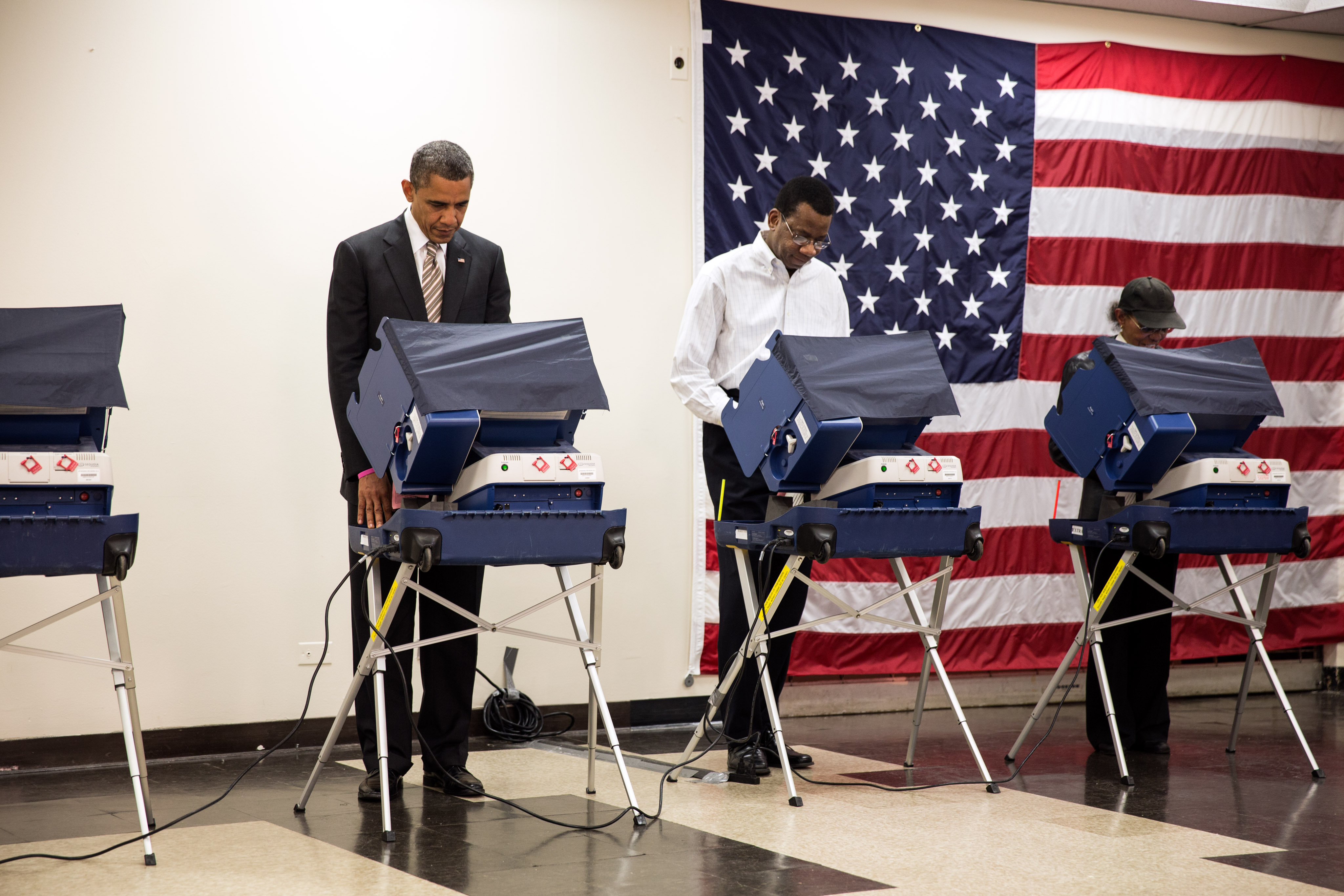
President Barack Obama voting in 2012.
The story of the secret ballot has alot of twists and turns with the ostensible rationale being to combat vote buying. But historians have pointed out that certain groups benefited from the switch to secret ballots more than others (particularly in the South were newly freed slaves were kept from voting because they couldn't pass a reading test to use the paper ballots). And if you think about it, does having someone's vote be secret actually combat the problem of vote buying? After all, the use of money in elections and out-right vote buying seems to have increased even after this supposed fix. But the full story of the secret ballot is for a different time. My aim is to give enough background to tell the story of how we got to an America where no one can verify their vote was counted properly or even at all.
The second component that adds to our situation is the ever-increasing and complicating rules of voting. And instead of ensuring every citizen has their vote counted, the rules seem to be focused more on restrictions and narrowing the pathway of when a vote counts. Some examples are states implementing voter roll purges using databases that have been shown time and again to be error prone. Some states even go so far as to require the names in the voter rolls to match exactly with government and private (!) databases. So if your voter registeration only has your first and last name and the database state officials are using has your middle name as well, then does that mean you get purged? Or, even more common, what if the database they are using has your name misspelled?
By the 2020s, three companies controlled roughly 90% of the voting systems in America. Most of their digital voting machines run on proprietary software which can't be independently audited by the public.
The third and most infuriating component, at least for me, is the privatizing of elections and election systems. This part has its modern, digital origins in the 2000 Presidential Election. The Florida recount, which saw the Supreme Court step in to stop the re-counting in that state without much of a rationale, revolved around poorly designed punch-card ballots. While news reports focused on the design of the ballot. The physical system that was used, developed and run by private companies, that had a history of errors and misreading ballots well before 2000. It was this disaster, mostly caused by a private voting machine manufacturer, that was used as a rationale for the 2002 Help America Vote Act, also known as HAVA. Under heavy lobbying by yet more private and corporate interests, HAVA set the stage to expand private industry's role in elections even more. And worse still, it made the preferred way of doing this something that was even less transparent and accountable than the votomatic machines of 2000.
But going back to the punch-card ballots in Broward County in Florida for a moment, they were at least physical and could be reviewed. Anyone who watched the news or late-night talk shows at the time remembers the public and sometimes akward examinations by election officials under the glare of cameras. You actually had people looking at a piece of phyiscal evidence that could be reviewed openly. What the 2002 law did was make digital voting the preferred method moving forward because it met the guidelines set forth in the law. And the shift to digital made it mostly unaccountable. Many electronic voting machines run on software that is proprietary and could not be independently audited. In other words, an election official and the public had to trust a company to tell them that everything worked ok with no way to verify if what they said was true. So much for checks and balances!
Although many historians point to Louisville as the first time secret ballots were used in the US, newspaper reports show them being used before 1888 in places such as Massachusetts and Utah.
There are other components to this problem but those three--the secret ballot, complex voting rules, and privatized election systems--are the aspects that are the drivers of the vast majority of our election problems. There is a fix to this in my view and it addresses almost all the concerns about elections--both those who think voter fraud is the problem (people voting when they shouldn't or voting multiple times) and those who see election fraud and suppression as the problem (shady election officials or private election system manufacturers). It involves going back to what we were doing before the Australian ballot (aka the secret ballot). But not completely--I don't think everyone showing up to shout their choice would help matters much. Instead, we should make everyone's choices open and part of the public record. If we did that then any voter fraud could easily be identified. And we would have a way to catch any funny business regarding the vote count or the mis-processing by the machines. It makes it all clear and in the open. And I'm not talking about cryptographic voting (basically still using some indirect checking method). Even with the most advanced cryptographic methods you're still creating a layer that obscures the actual votes.
Regardless if you think getting rid of the secret ballot is the way to go, the problems we face in ensuring our votes actually mean what we intend them to mean is a real problem that almost no one talks about. The only thing most people in Congress are focused on is your ID and adding yet more rules. All the while, every American is still wondering if their vote ever was counted in the first place.