There is a concept in sociology called the third place. It was coined by American sociologist Ray Oldenburg in his 1989 book, The Great Good Place: Cafes, Coffee Shops, Community Centers, General Stores, Bars, Hangouts, and How They Get You Through the Day. Whew, that title length alone deserves its own separate place! Anyway, the book outlines what a third place is in terms of what it means in people's daily lives.
The first place is one's home and involves activities related to private and family life. The second place is where one works, which often is the location where most people spend the majority of their waking lives (sadly). The second place can often be a school as well. The third place is different in the sense that it's not where you live or have to go. But rather, it's a place you go willingly and where you don't have any obligations like you do in the first two places.
The word "mall" comes from pall-mall, a 17th century ball game played in tree-lined alleys in England. The alleys became popular places for strolling when not used for pall-mall.
In the second place--whether work or school--you usually have an economic reason to be there and have to conform to various rules in order to continue going and being accepted. For instance, you can't just walk into work naked and not expect to be thrown out! Well, I guess it depends on where you work. But anyway. If you live with other family members, your first place can come with its own obligations. This could involve expectations of cooking or cleaning the house or anything else your spouse or kids might expect you to do. The places of work and home are pretty easy to imagine. So what exactly are considered third places where you don't have any pesky obligations?
Well, Oldenburg did spell them out by name in that long title I mentioned earlier. Geez, weren't you paying attention? But that subtitle list isn't exhaustive so I'll cut you some slack. In his book, he lists out seven characteristics of third places. I won't name them all and let you discover them in his book if you like. For the purpose of this article, I'll focus on the two I view as most important. The ones I consider the top characteristics are that these places are 1) open and inviting; and 2) comfortable and informal. A good example would be Floyd's barbershop on The Andy Griffith Show where Andy and others would just sit and gossip (it's an old show but if you don't know the reference, maybe try out an episode).
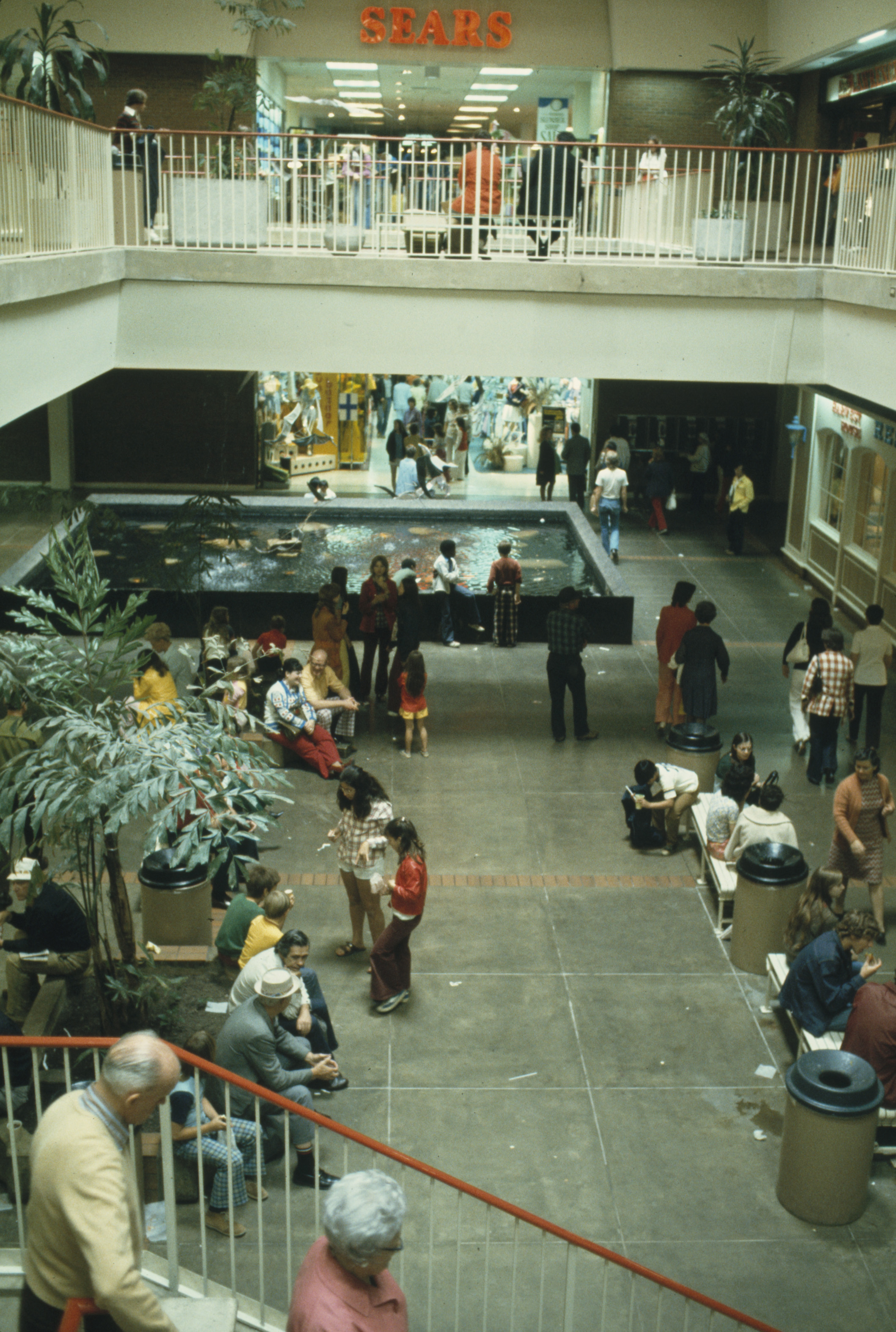
A shopping mall in Maryland in the 1970s.
America, for most of its existence, had the town square with local shops where people would just sit around and talk. In Europe, it's mostly the cafes and restaurants. But don't let those names fool you, they may ostensibly be for eating or drinking but in reality the people that go there mostly talk. And they talk for hours (seriously, when I lived in Italy I couldn't keep up with how long people stayed at a restaurant just talking). But starting in the late 1950s and picking up pace briskly in the 1960s, America's third place shifted. As commerce and home construction moved away from cities and towns and into new areas called suburbs, the third place shifted along with it. It moved into something called a shopping mall.
Now, I know what you're thinking--you go to malls to shop so there very much is an obligation expected when you get there. I would counter by pointing to the fact that I spent hours at the mall almost every weekend without buying a thing. This was not by choice, of course, since I would have bought so much if only I had a larger allowance. But anyway, the point is that the mall became a place where there was more than just teenagers hanging out. Sure, you had the Tiffany concerts (80s reference) and arcades, but you also had the political candidate speeches and holiday events like the arrival of Santa or the Easter Bunny bringing people out. You often ran into friends or got into random conversations with strangers. It was a town square that was climate controlled and where you could go buy an Orange Julius to enjoy while you stared at the water fountain. And you got all of this with no expectations from you.
One of the most popular "third places" in japan are convenient stores called konbini. People often stay for hours doing things like reading magazines or playing board games.
The shopping mall in America declined to the point where most smaller and medium-sized regional malls have basically disappeared. They were either bulldozed to the ground for presumable redevelopments or simply left vacant (take a look at what happened to the Mall of Memphis to see what the pattern is after mall closures--hint, it involves empty lots). And there has been no replacement to the third place that the malls provided. Back in the 1970s and 1980s people were presumably upset with malls replacing town squares but there is surprisingly little venting about how there is--for most Americans outside of major cities--no third place taking the mall's place. And the impact is more than just social. With the closure of malls, hundreds of direct jobs get lost. This includes not just the retailers but mall security, maintenance, and others working directly for the mall. But then you have the secondary job losses--the businesses and restaurants that built around the mall and took advantage of the mall's traffic. Once the mall left, many of those other businesses around it didn't move somewhere else. They just closed for good.
And if you think the decline of the mall in America was an inevitable consequence of internet shopping, I encourage you to see how they are performing in other countries. If it was simply internet shopping that caused the current reality then you would see the same levels of decline and dead malls as you do in America in other countries. But malls in Europe and Japan, for instance, are thriving. I go into the cause of the mall's decline in America in my video "Who Closed the Mall (It Wasn't Just the Internet)" and direct you there to find out more. But for my focus here, we've got a third place problem in America and no one seems to be talking about it. To go back to the Tiffany reference I made earlier, I'll end with a quote from one of her songs that I think sums up our predicament, "I think we're alone now." And there's no third place to break our solitude.